
The Big Feed
Australian not-for-profit focused on food education through a collective giving initiative.
Project type: UX Research
Timeline: Jul - Sept 2025 (7 weeks)
Project role: UX Researcher
Team: Part of a 8 person research team through the Harness Project, mentored by Warner Wong, Senior UX Researcher.
Key skills: Stakeholder interview, heuristic evaluation, competitive analysis, 3 user interviews, synthesis of 6 transcripts, archetype, recommendations report.
TL;DR
TL;DR
THE PROBLEM
The Big Feed's CEO believed dense text was preventing young donors (18–35 y/o) from donate to the Giving Circle. Research confirmed that was part of the problem, but two bigger barriers were hiding underneath it: a $50 entry point that priced out the exact audience she wanted to reach, and no visibility into where donations actually went.

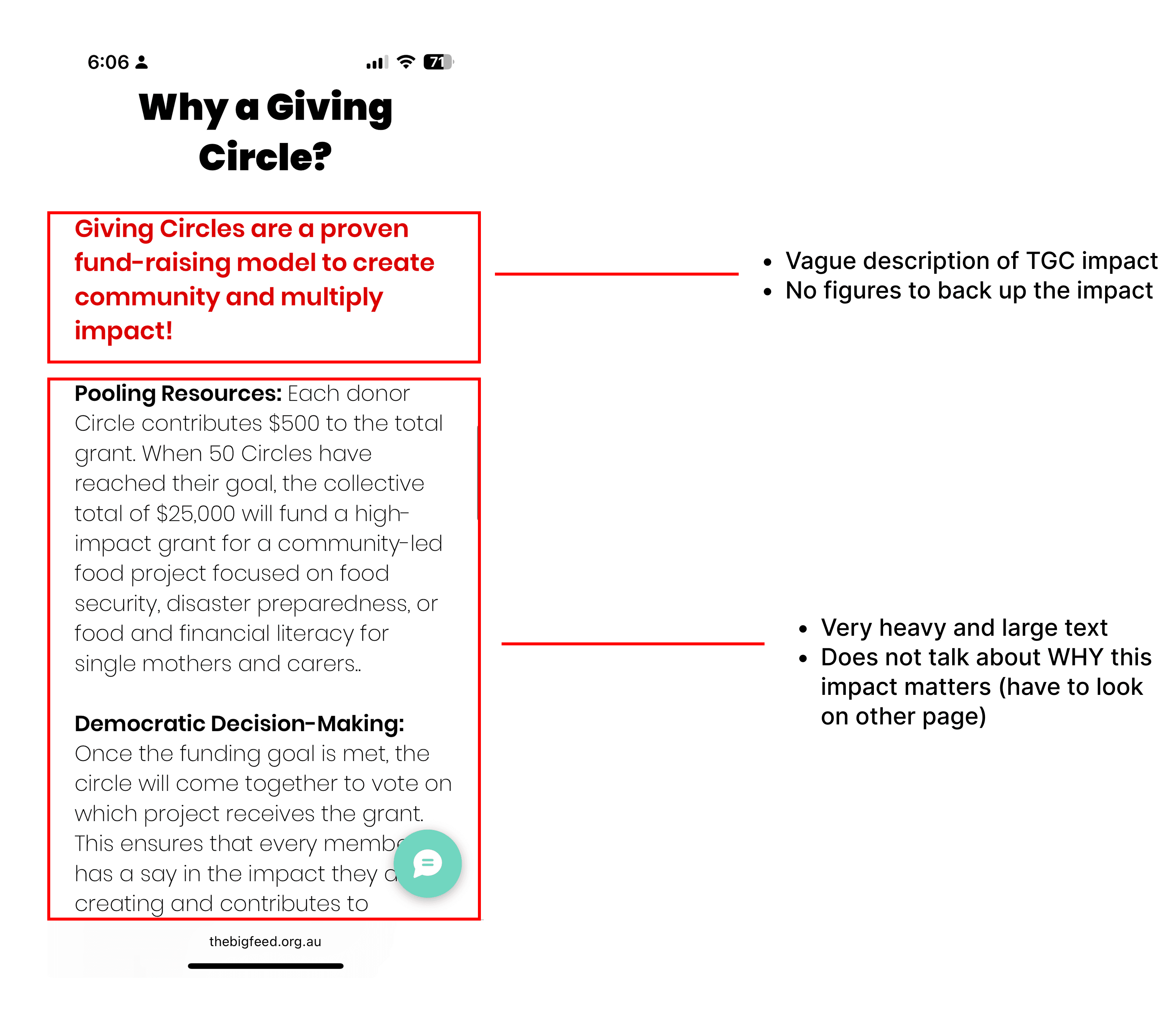
Vague description of TGC impact, no figures to support impact, text heavy statement
RECOMMENDATIONS
#1
Highlight communities directly impacted by donations through social media using student volunteers for work .
#2
Provide impact receipts after every donation, closing a donor journey that currently ends at payment with no follow-up.
#3
Introduce micro circles, starting at a $5 entry point to convert priced-out young donors to participate and to becoming future full Giving Circle members
OUTCOME
Delivered 3 prioritised recommendations to the CEO. The donation heat map from the report is being added to The Big Feed's live website.
Here's the theory I was brought in to test, once I understood who I was actually researching for.
The Big Feed
Australian not-for-profit focused on food education through a collective giving initiative.
Project type: UX Research
Timeline: Jul - Sept 2025 (7 weeks)
Project role: UX Researcher
Team: Part of a 8 person research team through the Harness Project, mentored by Warner Wong, Senior UX Researcher.
Key skills: Stakeholder interview, heuristic evaluation, competitive analysis, 3 user interviews, synthesis of 6 transcripts, archetype, recommendations report.
The Big Feed
Australian not-for-profit focused on food education through a collective giving initiative.
Project type: UX Research
Timeline: Jul - Sept 2025 (7 weeks)
Project role: UX Researcher
Team: Part of a 8 person research team through the Harness Project, mentored by Warner Wong, Senior UX Researcher.
Key skills: Stakeholder interview, heuristic evaluation, competitive analysis, 3 user interviews, synthesis of 6 transcripts, archetype, recommendations report.
The Big Feed supports regional and remote Australian communities thro
TL;DR
TL;DR
The problem
remote Australian communities thro
RSPCA's Knowledge Base serves three audiences, pet owners, vet students, and farmers, on the same pages. Searching "how to train dogs" will get you pet transport carrier advice next to glue board legalities, with no way in filtering the results. For a pet owner trying to help their pet, that means digging through content that was never meant for them.
Recommendations
#1
Highlight communities directly impacted by donations through social media using student volunteers for work .
#2
Provide impact receipts after every donation, closing a donor journey that currently ends at payment with no follow-up.
#3
Introduce micro circles, starting at a $5 entry point to convert priced-out young donors to participate and to becoming future full Giving Circle members
#1
Highlight communities directly impacted by donations through social media using student volunteers for work .
#2
Provide impact receipts after every donation, closing a donor journey that currently ends at payment with no follow-up.
#3
Introduce micro circles, starting at a $5 entry point to convert priced-out young donors to participate and to becoming future full Giving Circle members
Outcome
Delivered 3 prioritised recommendations to the CEO. The donation heat map from the report is being added to The Big Feed's live website.
Here's the theory I was brought in to test, once I understood who I was actually researching for.
Outcome
Delivered 3 prioritised recommendations to the CEO. The donation heat map from the report is being added to The Big Feed's live website.
Here's the theory I was brought in to test, once I understood who I was actually researching for.
⤵
The Big Feed supports regional and remote Australian communities through food education and do
TL;DR
THE PROBLEM
The Big Feed's CEO believed dense text was preventing young donors (18–35 y/o) from donate to the Giving Circle. Research confirmed that was part of the problem, but two bigger barriers were hiding underneath it: a $50 entry point that priced out the exact audience she wanted to reach, and no visibility into where donations actually went.
Vague description of TGC impact, no figures to support impact, text heavy statement
RECOMMENDATIONS
#1
Highlight communities directly impacted by donations through social media using student volunteers for work .
#2
Provide impact receipts after every donation, closing a donor journey that currently ends at payment with no follow-up.
#3
Introduce micro circles, starting at a $5 entry point to convert priced-out young donors to participate and to becoming future full Giving Circle members
OUTCOME
Delivered 3 prioritised recommendations to the CEO. The donation heat map from the report is being added to The Big Feed's live website.
This is the theory I was brought in to test, once I understood who I was actually researching for —>
This is the theory I was brought in to test, once I understood who I was actually researching for —>
PROJECT OVERVIEW
The client
The Big Feed supports regional and remote Australian communities through food education and donations. Its flagship initiative, the Giving Circle, lets groups of up to 10 people pool donations (combined with other circles) to fund one large community food project grant each year.
Kay's problem
Kay Richardson, The Big Feed's CEO, partnered with the Harness Project group to identify what was preventing young donors (18–35 y/o) from donating and participating, the audience the organisation needs for long-term growth. As part of that team, I conducted a stakeholder interview with Kay to understand her challenges and goals.
The starting hypothesis
From my own early evaluation of the site, I formed a working hypothesis: young donors aren't grasping the impact of the Giving Circle because the donation context is buried in dense text.
My job was to test this theory with actual young donor behaviour.
Research constraints
Recruitment
We couldn't access The Big Feed's existing donors, so we recruited through the Harness Project's network. Findings reflect prospective young donors, not current ones.
Sample
The team ran 26 interviews (I conducted 3). For analysis, I focused on the 6 participants who matched the target profile (18–35 y/o), interested in social causes, familiar with food insecurity. Excluding the other 20 kept the insights relevant to Kay's growth audience, at the cost of a very small sample. I report findings as counts, not percentages, for that reason.
BACKGROUND RESERCH
Grounding myself in the current site
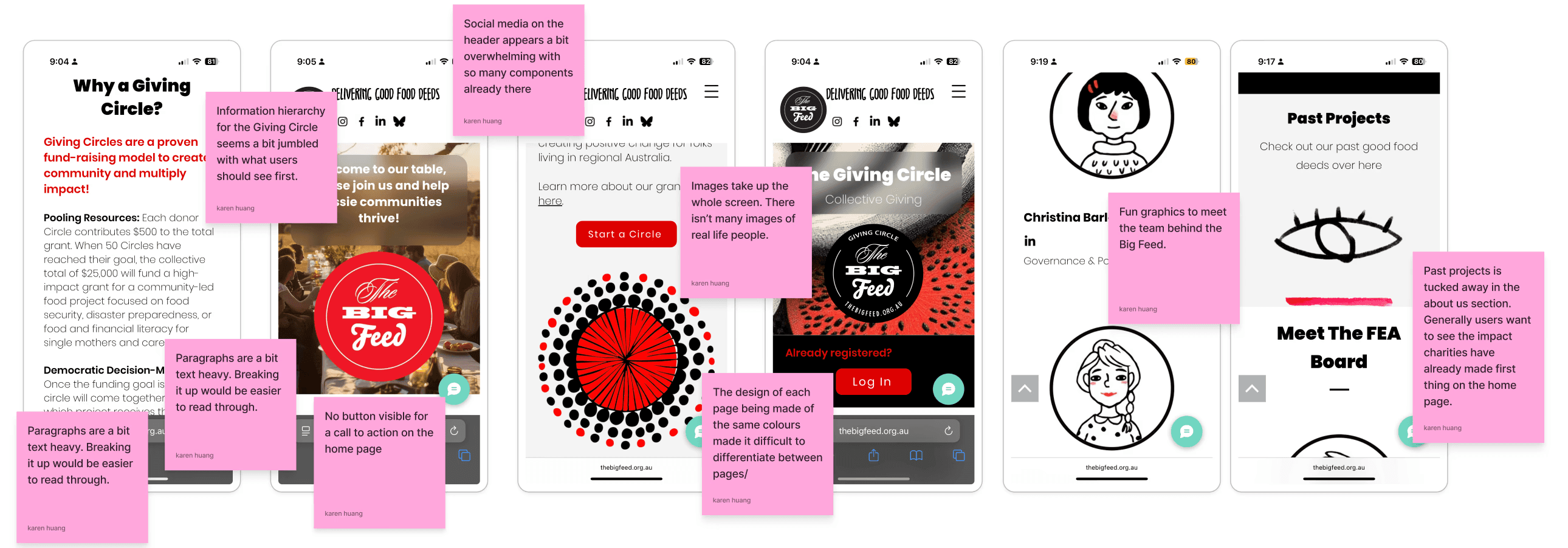
Before talking to users, I evaluated the existing site against Nielsen Norman's usability heuristics to build a baseline and to develop my interview focus.
What stood out
No visible call to action on the home page — no clear starting point.
Impact evidence (past projects & donation outcomes) buried in "About us" section rather than surfaced where donation decisions happen.
Text-heavy pages with little real-life imagery.
A uniform colour palette across every page, making it hard to tell sections apart.
How this shaped the interviews
Rather than researching broadly, I probed three specific questions:
Can users find donation impact information?
Does the missing CTA stall them?
Does the visual sameness cause disorientation?
Familiarising myself with competitors
I compared two organisations running similar grant models across strengths, weaknesses, donor engagement strategy, incentives, and grant guidelines.
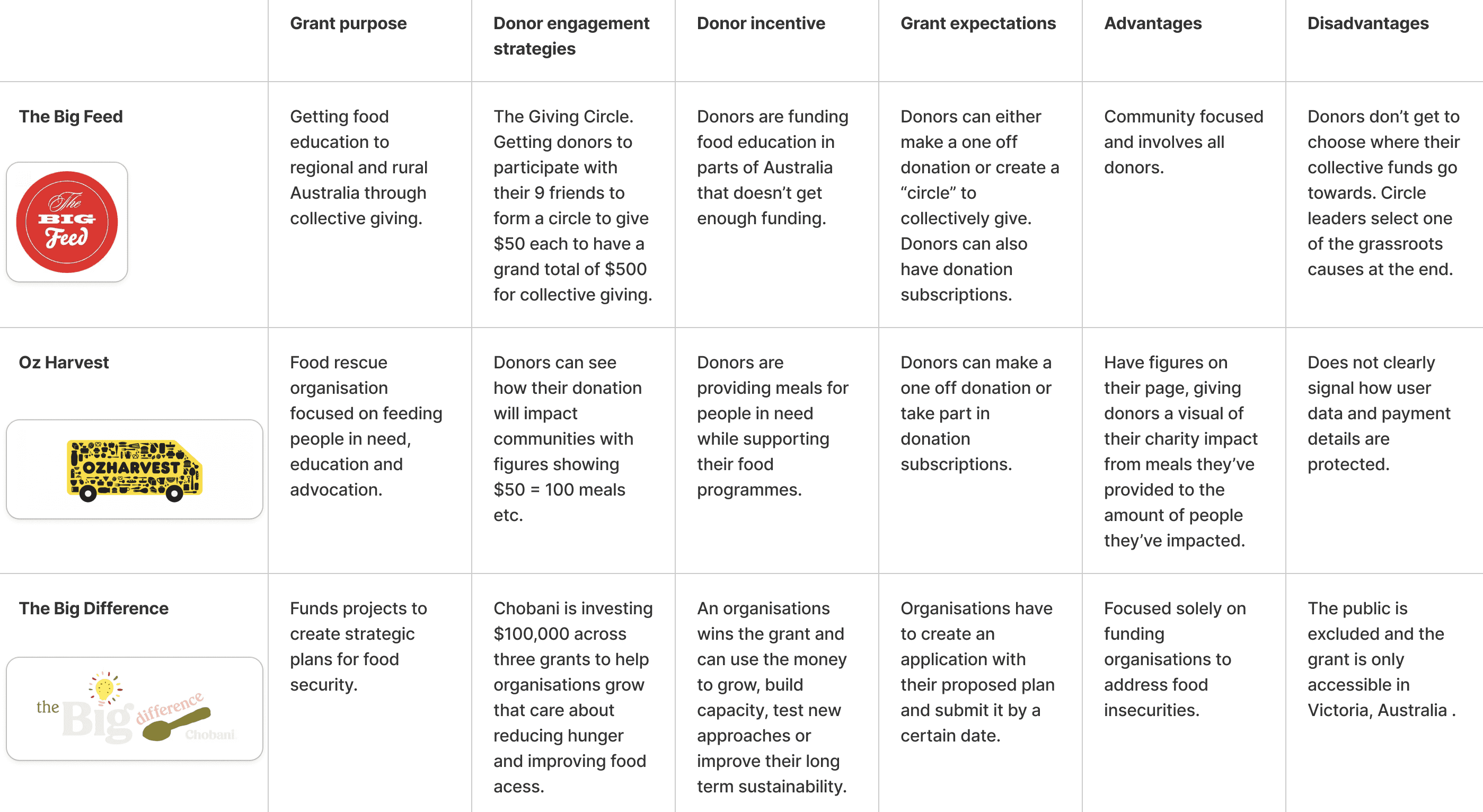
Two patterns showed up in every competitor, and both later appeared independently in my interview data:
Concrete figures build confidence — donors trust organisations that show numbers.
Real faces and stories create connection — imagery of actual beneficiaries, not stock photography or AI generated.
Both patterns fed directly into my top recommendations.
The survey that failed and what I'd change
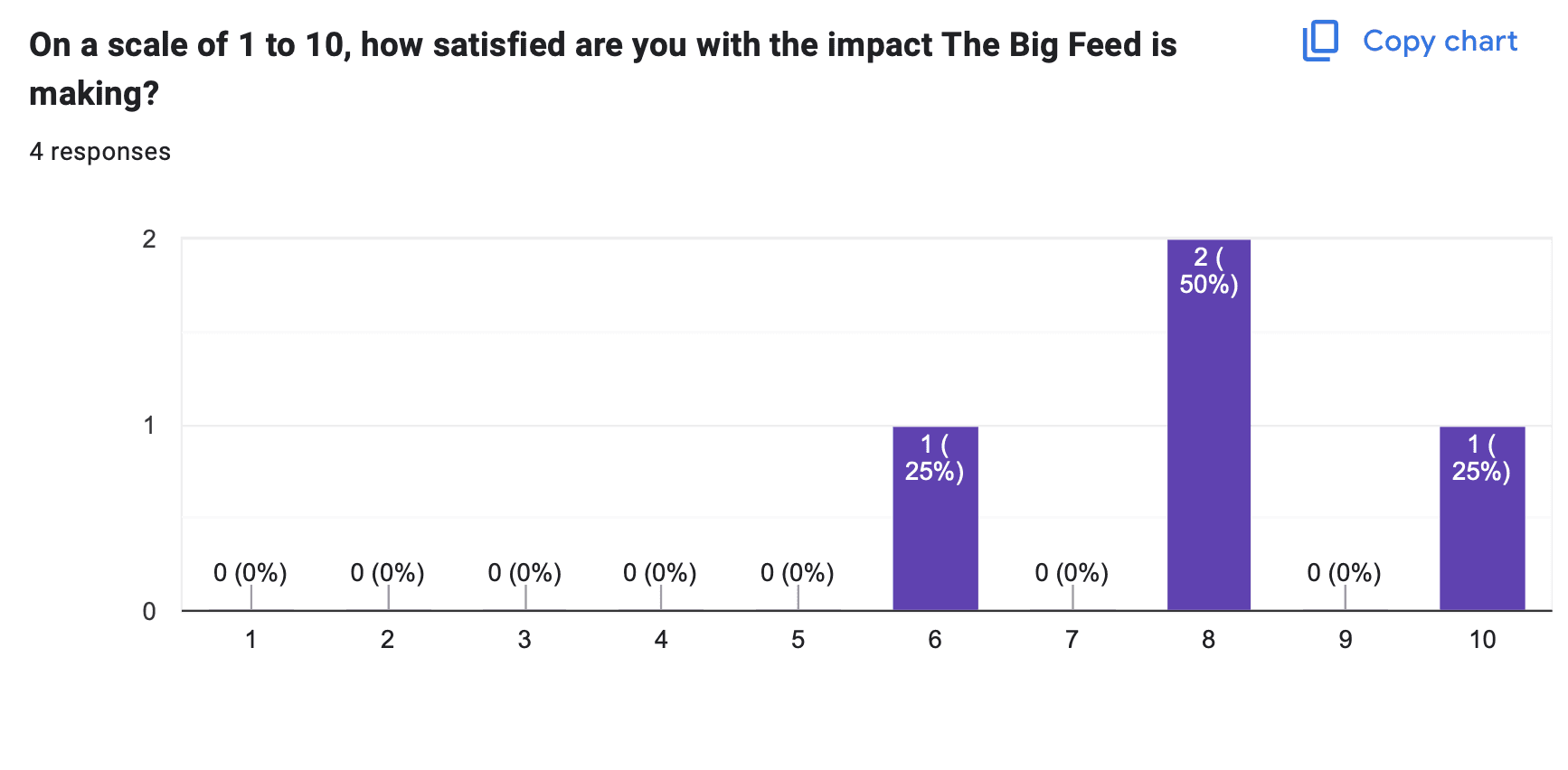
A survey was created by members of the design team to gather a better understanding of the Big Feed members needs and satisfaction.
Diagnosis: The survey was distributed through a single newsletter send via Heartbeat, The Big Feed's community platform. Since we didn't have direct access to the donor community, Kay handled distribution on our behalf, one send, no incentive, and no follow-up reminder. That was likely too little to prompt response from a busy or already-occupied community.
Next time, I'd: design the distribution plan more collaboratively with Kay upfront, shorter survey length, a small incentive, and at least one reminder send, rather than assuming a single newsletter mention would be enough.
USER INTERVIEWS
Method:
26 semi-structured interviews across the team (in person and Zoom);
I conducted 3 interviews. I analysed 6 of the 26 that matched the target donor profile.
I reviewed each of the 6 participant transcripts and grouped observations into recurring themes. To guard against my own bias and confirm I wasn't missing patterns, I probed AI with questions against the transcripts as a check, comparing its read against my own before finalising each theme.
Interview goals
Understand what blocks young people from donating through the Giving Circle.
Identify what actually motivates them to give and to give again.
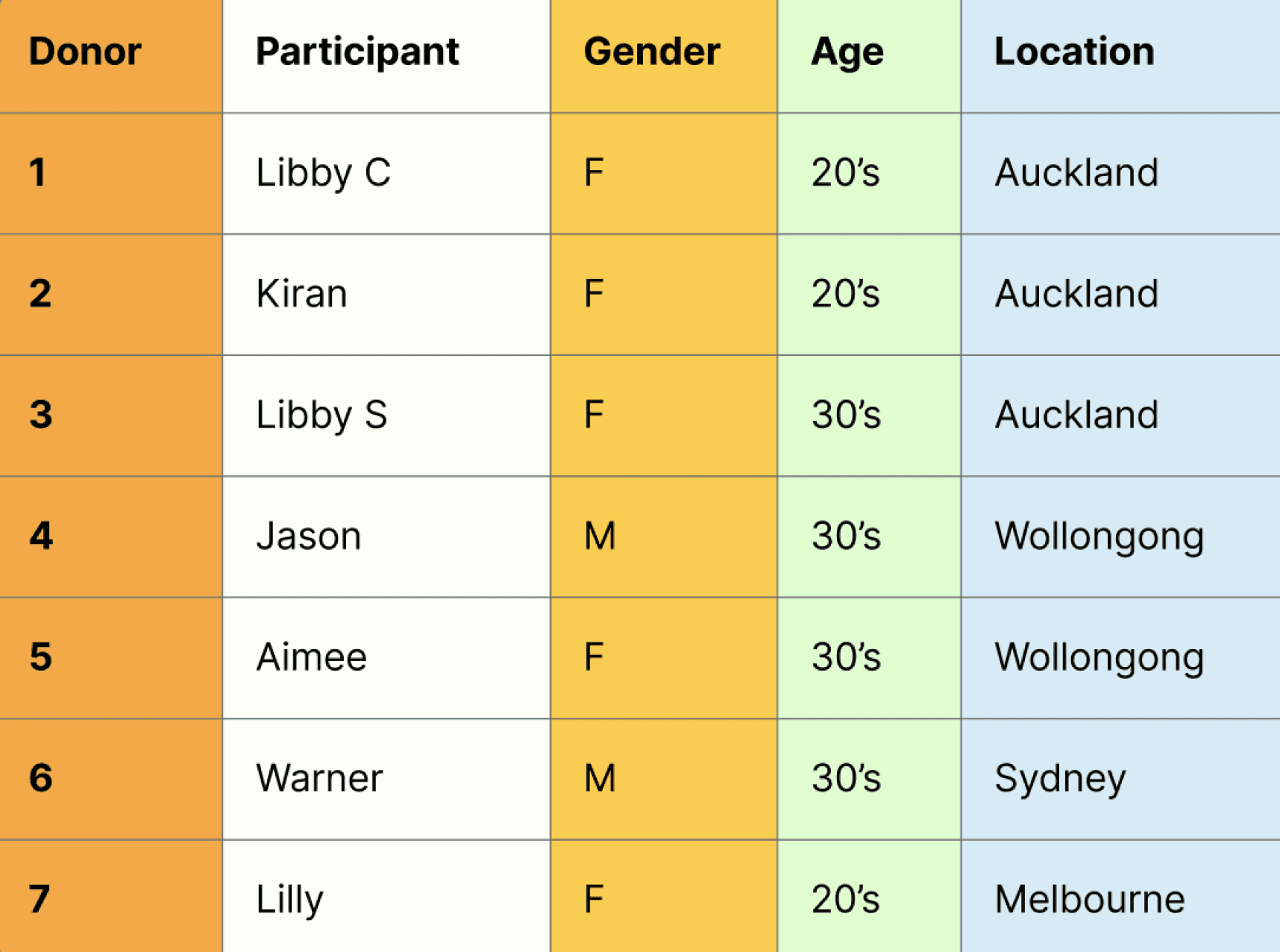
PROJECT OVERVIEW
The client
The Big Feed supports regional and remote Australian communities through food education and donations. Its flagship initiative, the Giving Circle, lets groups of up to 10 people pool donations (combined with other circles) to fund one large community food project grant each year.
Kay's problem
Kay Richardson, The Big Feed's CEO, partnered with the Harness Project group to identify what was preventing young donors (18–35 y/o) from donating and participating, the audience the organisation needs for long-term growth. As part of that team, I conducted a stakeholder interview with Kay to understand her challenges and goals.
The starting hypothesis
From my own early evaluation of the site, I formed a working hypothesis: young donors aren't grasping the impact of the Giving Circle because the donation context is buried in dense text.
My job was to test this theory with actual young donor behaviour.
Research constraints
Recruitment
We couldn't access The Big Feed's existing donors, so we recruited through the Harness Project's network. Findings reflect prospective young donors, not current ones.
Sample
The team ran 26 interviews (I conducted 3). For analysis, I focused on the 6 participants who matched the target profile (18–35 y/o), interested in social causes, familiar with food insecurity. Excluding the other 20 kept the insights relevant to Kay's growth audience, at the cost of a very small sample. I report findings as counts, not percentages, for that reason.
BACKGROUND RESERCH
Grounding myself in the current site
Before talking to users, I evaluated the existing site against Nielsen Norman's usability heuristics to build a baseline and to develop my interview focus.
What stood out
No visible call to action on the home page — no clear starting point.
Impact evidence (past projects & donation outcomes) buried in "About us" section rather than surfaced where donation decisions happen.
Text-heavy pages with little real-life imagery.
A uniform colour palette across every page, making it hard to tell sections apart.
How this shaped the interviews
Rather than researching broadly, I probed three specific questions:
Can users find donation impact information?
Does the missing CTA stall them?
Does the visual sameness cause disorientation?
Familiarising myself with competitors
I compared two organisations running similar grant models across strengths, weaknesses, donor engagement strategy, incentives, and grant guidelines.
Two patterns showed up in every competitor, and both later appeared independently in my interview data:
Concrete figures build confidence — donors trust organisations that show numbers.
Real faces and stories create connection — imagery of actual beneficiaries, not stock photography or AI generated.
Both patterns fed directly into my top recommendations.
The survey that failed and what I'd change
A survey was created by members of the design team to gather a better understanding of the Big Feed members needs and satisfaction.
Diagnosis: The survey was distributed through a single newsletter send via Heartbeat, The Big Feed's community platform. Since we didn't have direct access to the donor community, Kay handled distribution on our behalf, one send, no incentive, and no follow-up reminder. That was likely too little to prompt response from a busy or already-occupied community.
Next time, I'd: design the distribution plan more collaboratively with Kay upfront, shorter survey length, a small incentive, and at least one reminder send, rather than assuming a single newsletter mention would be enough.
USER INTERVIEWS
Method:
26 semi-structured interviews across the team (in person and Zoom);
I conducted 3 interviews. I analysed 6 of the 26 that matched the target donor profile.
I reviewed each of the 6 participant transcripts and grouped observations into recurring themes. To guard against my own bias and confirm I wasn't missing patterns, I probed AI with questions against the transcripts as a check, comparing its read against my own before finalising each theme.
Interview goals
Understand what blocks young people from donating through the Giving Circle.
Identify what actually motivates them to give and to give again.

"I would donate $20–$40 because it’s what I can give without putting myself under financial strain."
Interview quote from Kiran
"Usually I don't give $50 for donations… I usually give about $10 or $20."
Interview quote from Aimee
Insight 1 — The Giving Circle's message drowns in its own page
3 out of 6 participants struggled to extract the Giving Circle's purpose from the dense text, re-reading sections and still misunderstanding the model. This validated my hypothesis.
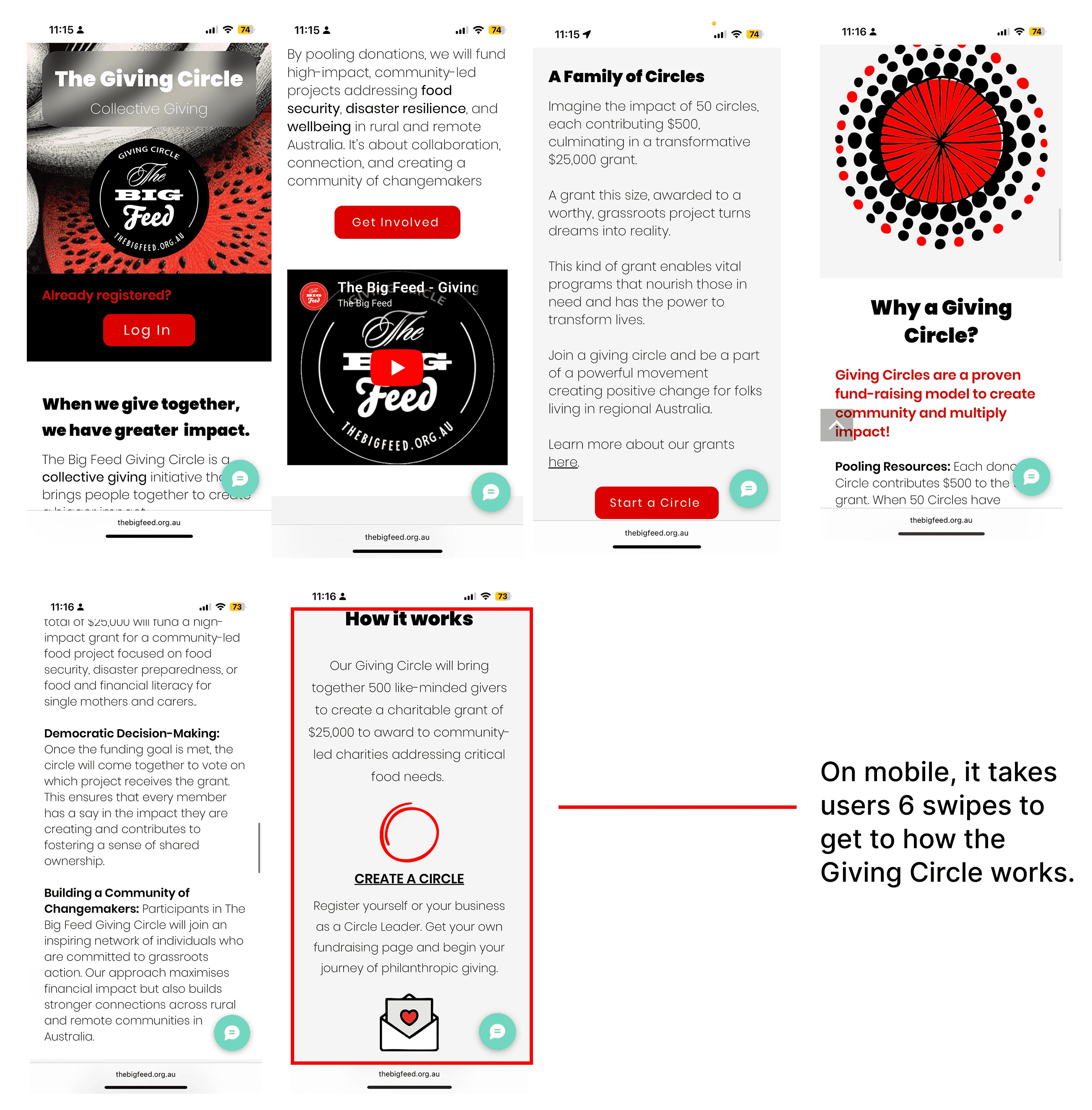
"The concept makes sense to me. However, I do think that it's not visually laid out in terms of how the concept works."
Interview quote from Jason
Insight 2 — The $50 entry point prices out the audience Kay wants
4 out of 7 participants wanted to participate but found $50 as a financial barrier.
Students and young professionals gave $10–$40 as their comfortable range. The prospect of assembling a 10-person circle intimidated them further.
"$50 is like a uni students food shop. This initiative can be something that you're able to do with your friends like buying a few extra things in the grocery each week, that they can pass on."
Interview quote from Kiran
Insight 3 — No transparency, no donation
6 of 7 participants wouldn't donate without knowing where their money goes. They couldn't see how The Big Feed converts donations into community impact, and some felt the supported causes didn't represent communities they cared about
6 of 7 participants wouldn't donate without knowing where their money goes. They couldn't see how The Big Feed converts donations into community impact, and some felt the supported causes didn't represent communities they cared about.
"I wouldn't be comfortable giving money unless there's more specifics around how the money is actually spent and how much of it goes to the actual recipient."
Interview quote from Jason
ARCHETYPE

Trudy — The cautious first time donor
Trudy synthesises the patterns across all 6 interviews: motivated to give, but only when trust is earned first.
"Knowing which communities are in need and how the money reaches them would motivate me to contribute more."
Trudy
Who is she:
Trust orientated, values driven & pragmatic.
Wants to belong to something bigger than herself, and spreads her giving across multiple causes.
What she needs before she donates:
Visible proof of where money goes and what it changes.
Causes that reflect her values and communities she recognises.
An entry point that fits a young professional's budget.
What makes her leave:
Dense, unstructured content she has to work to decode.
No clear next step when she's ready to act.
Where the journey breaks
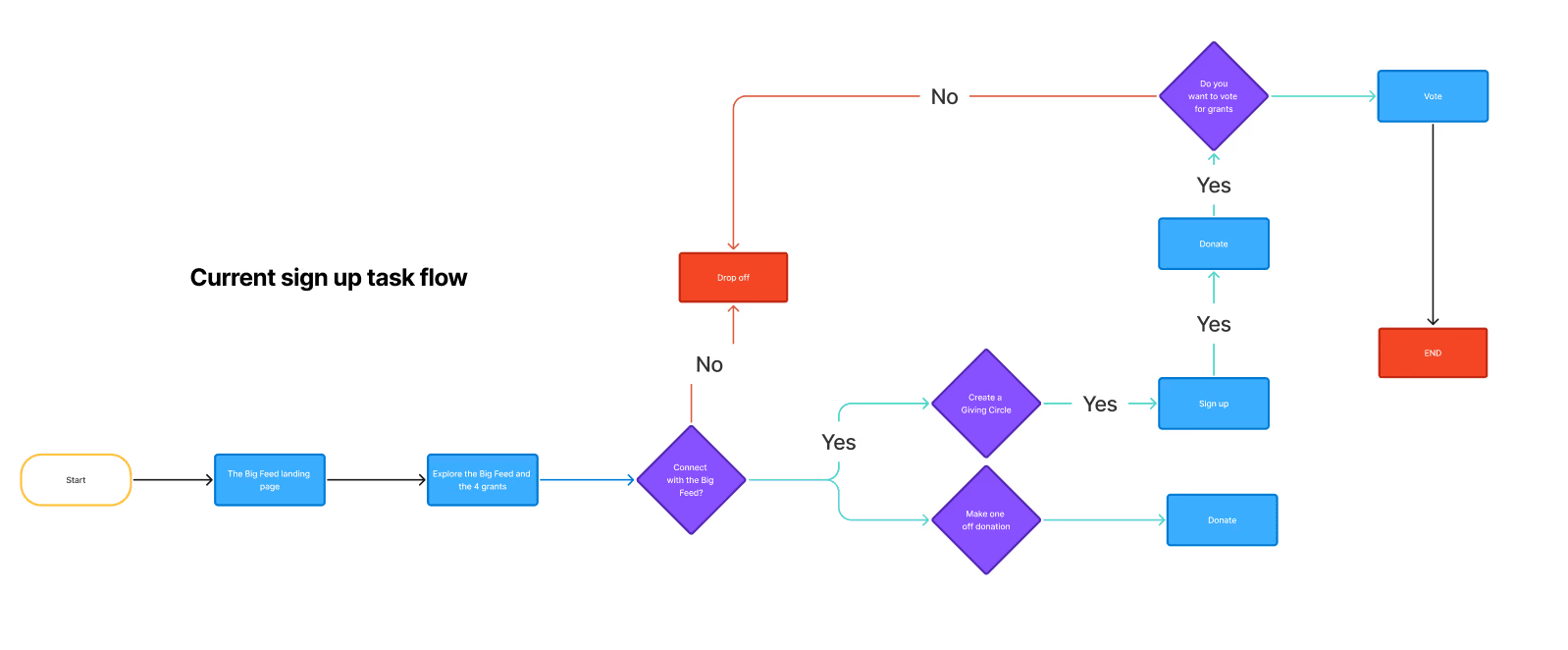
I mapped the current donation task flow and marked the friction points inferred from interview accounts (where participants described hesitating, losing the thread, or giving up).
The clearest break:
The journey ends at the payment confirmation. No follow-up, no impact report, nothing to bring a donor back. This directly feeds to Insight 3.
RECOMMENDATIONS

I mapped every recommendation on an impact/effort matrix with effort estimates checked against Kay's team capacity. I led with the three highest leverage moves.
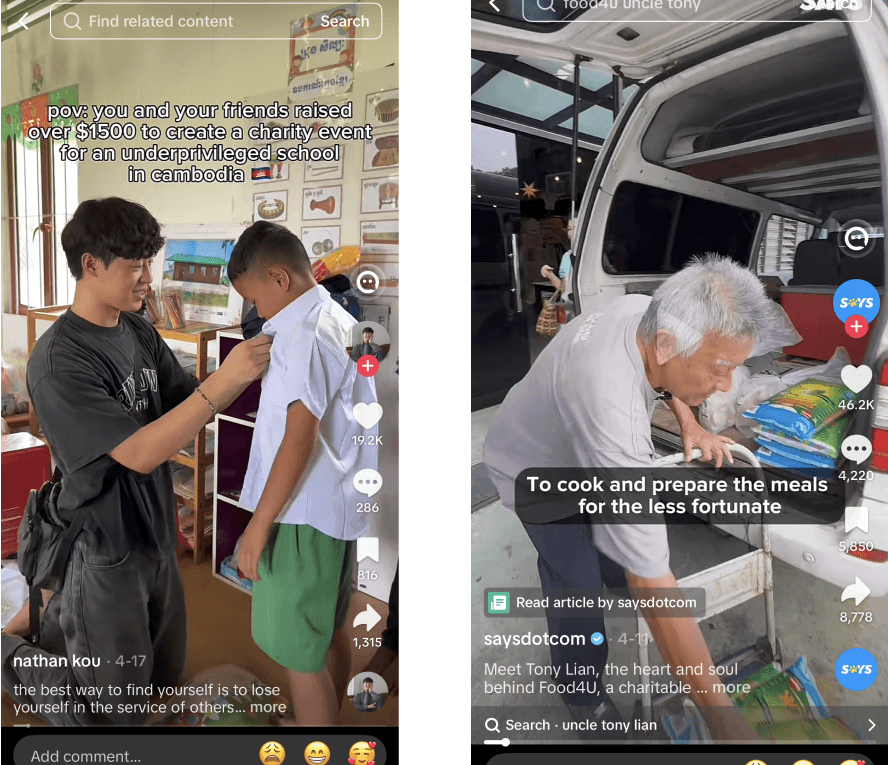
Tell impact stories on social media
HIGH IMPACT, MODERATE EFFORT
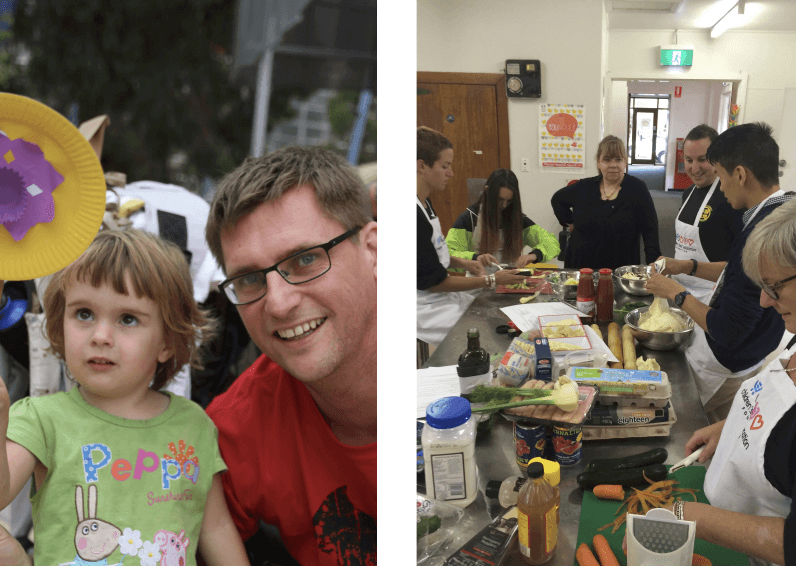
Recruit students volunteers to document the communities each grant reaches.
This builds trust through social proof and meets the (18-35 y/o) audience where they already are.
Requires time, planning, travel, and consistent updates, which is why its paired with volunteer pipeline rather than staff time.
“Food education has a massive impact… especially in rural areas where access is limited.” - Libby
Send impact receipts after every donation
HIGH IMPACT, MODERATE EFFORT
Close the loop that currently ends at payment: show each donor what their contribution funded, with progress updates through email or the Heartbeat community.
Directly answers the transparency barrier from insight 3 (no transparency, no donation).
“The (donation) emails remind me when it’s time to donate.” - Libby
“Show me the impact afterwards so I feel inspired to give again.” - Jason
Introduce micro circles
MODERATE IMPACT, LOW EFFORT
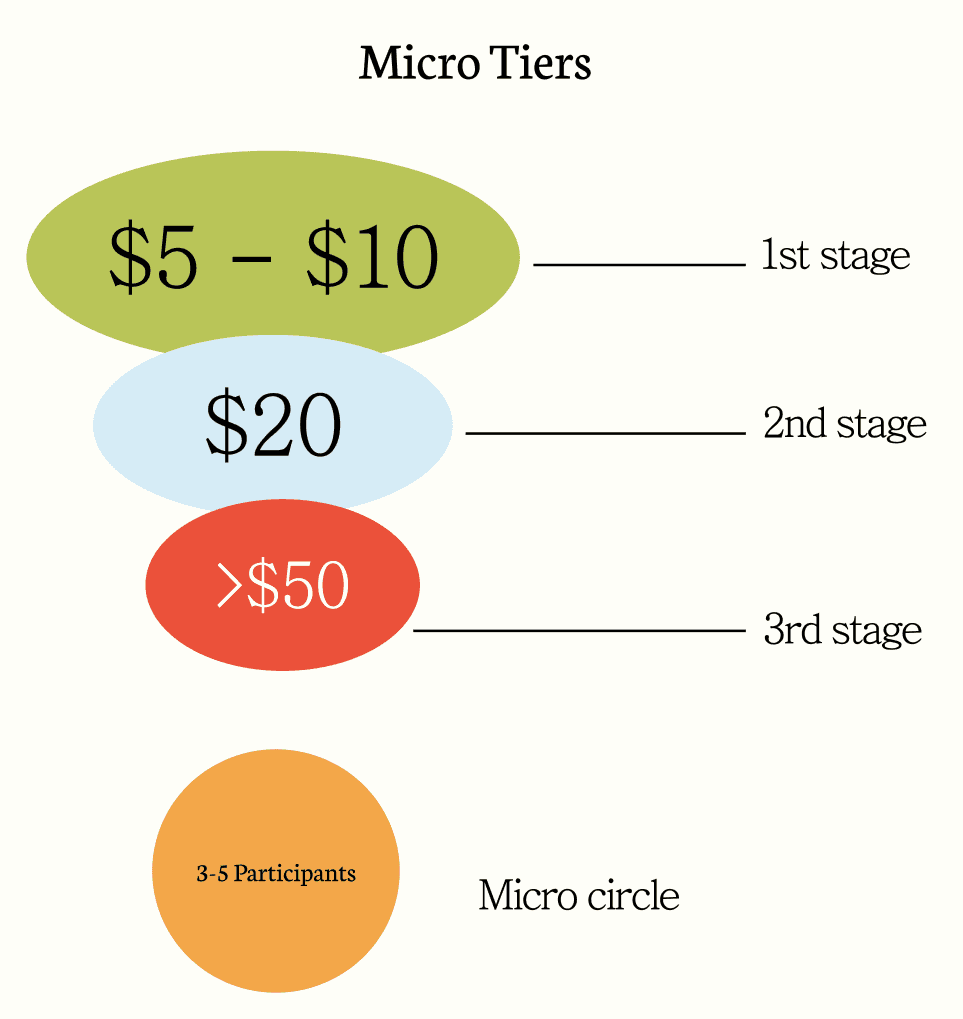
Smaller circles (3–5 people) with a $5 minimum designed to start engaging donors into the Giving Circles.
This lowers the barrier from insight 2 ($50 entry barrier), while protecting the core funding model. Micro circle donors are prospects being warmed up to be full $50 donors.
Tradeoff acknowledged: micro contributions won't meaningfully fund grants on their own. The value is donor acquisition. Converting priced-out young donors into future full-circle members.
Further recommendations
Tell impact stories on social media
HIGH IMPACT, MODERATE EFFORT
Recruit students volunteers to document the communities each grant reaches.
This builds trust through social proof and meets the (18-35 y/o) audience where they already are.
Requires time, planning, travel, and consistent updates, which is why its paired with volunteer pipeline rather than staff time.
“Food education has a massive impact… especially in rural areas where access is limited.” - Libby
Send impact receipts after every donation
HIGH IMPACT, MODERATE EFFORT
Close the loop that currently ends at payment: show each donor what their contribution funded, with progress updates through email or the Heartbeat community.
Directly answers the transparency barrier from insight 3 (no transparency, no donation).
“The (donation) emails remind me when it’s time to donate.” - Libby
“Show me the impact afterwards so I feel inspired to give again.” - Jason
Introduce micro circles
MODERATE IMPACT, LOW EFFORT
Smaller circles (3–5 people) with a $5 minimum designed to start engaging donors into the Giving Circles.
This lowers the barrier from insight 2 ($50 entry barrier), while protecting the core funding model. Micro circle donors are prospects being warmed up to be full $50 donors.
Tradeoff acknowledged: micro contributions won't meaningfully fund grants on their own. The value is donor acquisition. Converting priced-out young donors into future full-circle members.
Further recommendations
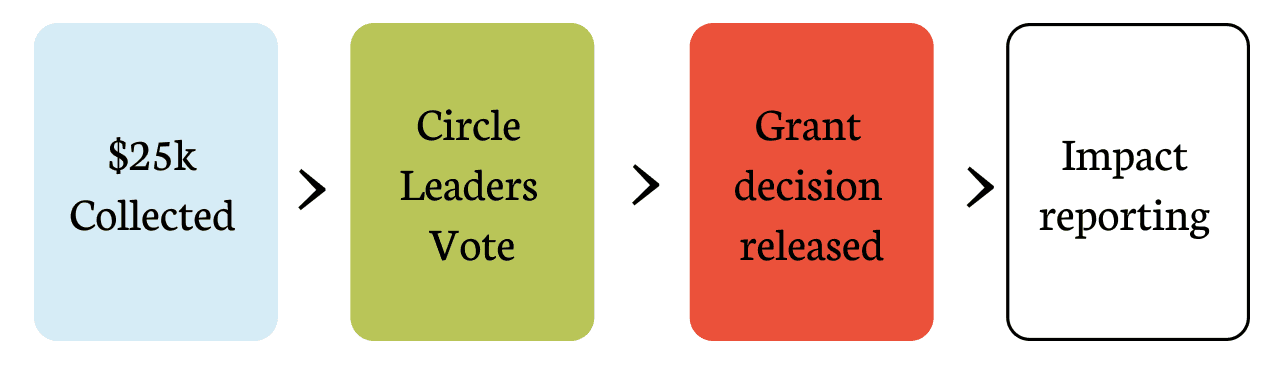
Show the numbers
Donors trust figures. Display total raised, active circles, and recent contributions on the site.
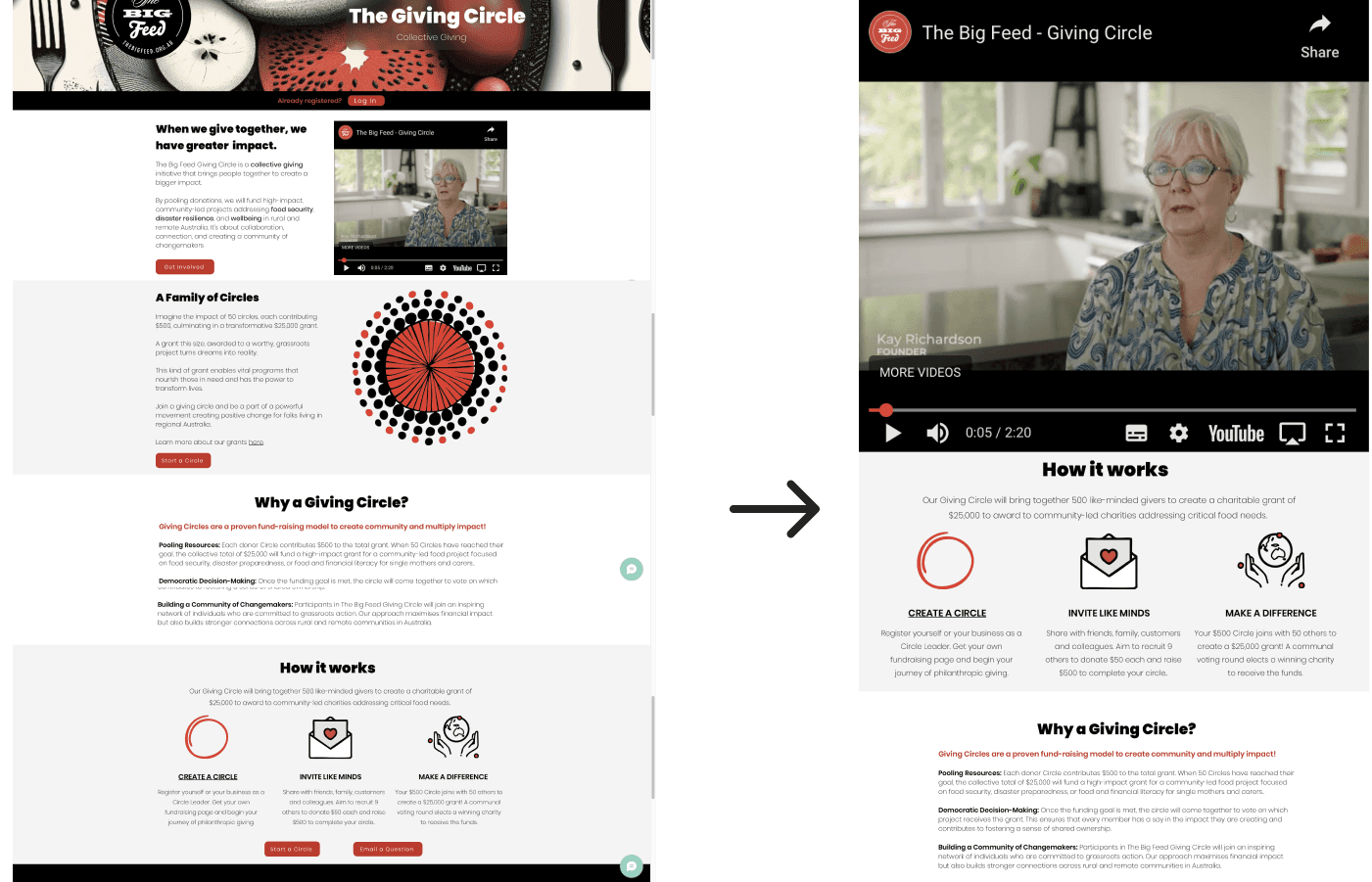
Restructure the Giving Circle page
Give breathing room for the video. Allow the video to take space on the page so that its not buried among the paragraphs of text.
"By only giving this to the people who are able to contribute with money, they're missing out on extra help that might be out there for them. Some people can contribute with time, but not money."
Interview quote from Libby C
Offer non financial participation
Volunteering, mentoring, and skill sharing routes for people with time but not money.
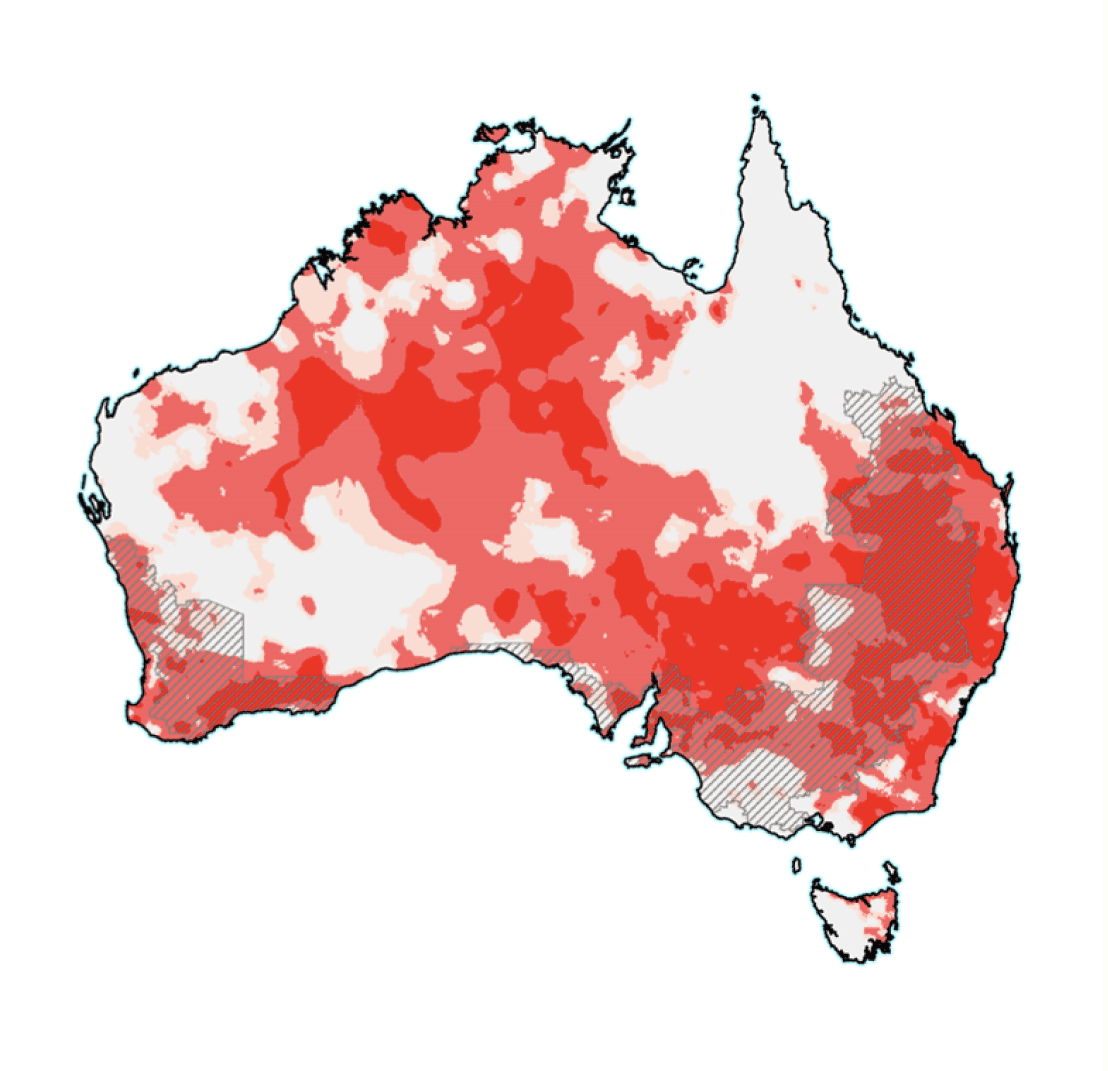
Let donors shape the causes
Circle leader voting on next year's grassroots grants, plus an interactive map of the regions the grants has supported. Turns impact into something explorable.
(The interactive map Kay is implementing to the website)
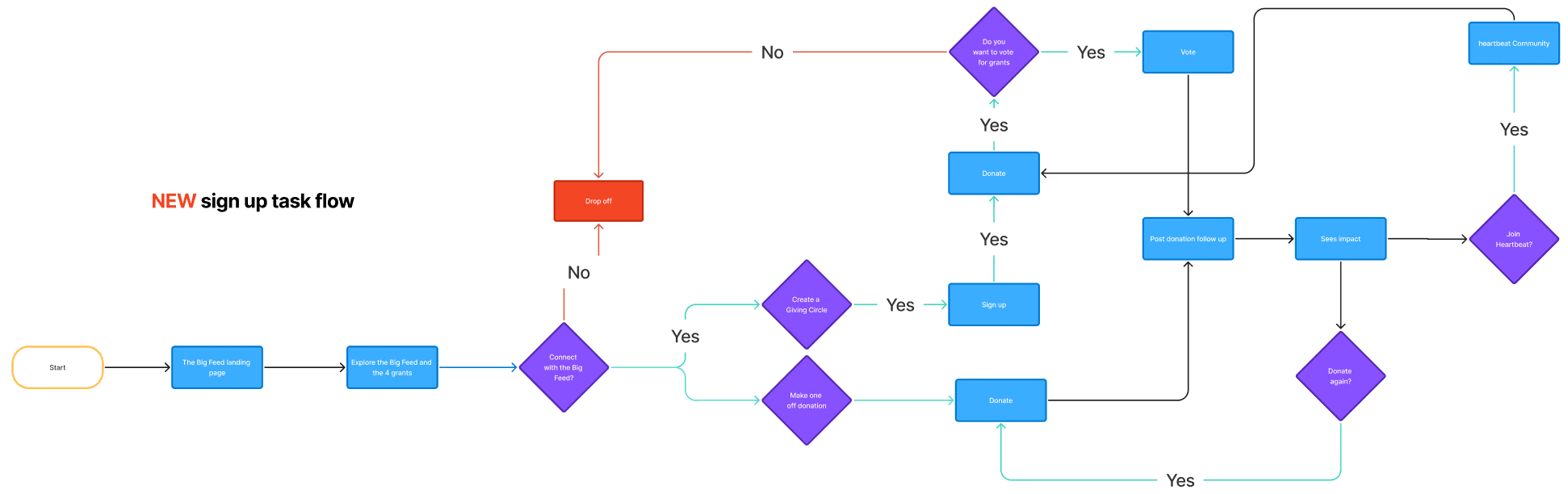
The redesigned journey
The updated task flow shows where the recommendations intervene: a clearer entry point, a lower-commitment first donation, and a journey that continues after payment instead of ending there.
REFLECTION
What I learned
Asking thought provoking questions and why encourages users to explain their actions, revealing deeper insights into their behaviour. Probing users on their donation behaviours revealed their motivations to give.
Slowing down and critically examine my thought process. Poking holes in my assumptions allowed me to identify gaps I might be missing and could expand further.
What I'd do next for the Big Feed
Validate the inferred friction points against actual site analytics.
Interview current Big Feed donors (not just prospects) to understand what sustains repeat giving.
Pilot the micro circle model with one small cohort to test whether a lower-commitment entry point converts priced-out young donors into future full Giving Circle members
Feedback
Kay Richardson - Executive director & founder of the Big Feed
"I liked how you structured your narrative. I appreciate the storytelling techniques you used to visual the issues you discovered in your research. The heat map is a really idea I'm going to include to our website."
Warner Wong - Senior UX Researcher, Mentor
"I liked how you structured your narrative. I appreciate the storytelling techniques you used to visual the issues you discovered in your research. The heat map is a really idea I'm going to include to our website."
Up next…
RSPCA Knowledge Base
Helping pet owners actually find answers in RSPCA's Knowledge Base
View Project
Youngster
Why young people weren't finishing Youngster's sign-up, and what was missing at every step
View Project
Karen Huang
Thank you for your interest in my work!
If you’re looking for a UX Designer who cares a lot and loves a good laugh, send me a message, I’d love to connect!
"I would donate $20–$40 because it’s what I can give without putting myself under financial strain."
Interview quote from Kiran
"Usually I don't give $50 for donations… I usually give about $10 or $20."
Interview quote from Aimee
Insight 1 — The Giving Circle's message drowns in its own page
3 out of 6 participants struggled to extract the Giving Circle's purpose from the dense text, re-reading sections and still misunderstanding the model. This validated my hypothesis.
"The concept makes sense to me. However, I do think that it's not visually laid out in terms of how the concept works."
Interview quote from Jason
Insight 2 — The $50 entry point prices out the audience Kay wants
4 out of 7 participants wanted to participate but found $50 as a financial barrier.
Students and young professionals gave $10–$40 as their comfortable range. The prospect of assembling a 10-person circle intimidated them further.
"$50 is like a uni students food shop. This initiative can be something that you're able to do with your friends like buying a few extra things in the grocery each week, that they can pass on."
Interview quote from Kiran
Insight 3 — No transparency, no donation
6 of 7 participants wouldn't donate without knowing where their money goes. They couldn't see how The Big Feed converts donations into community impact, and some felt the supported causes didn't represent communities they cared about
"I wouldn't be comfortable giving money unless there's more specifics around how the money is actually spent and how much of it goes to the actual recipient."
Interview quote from Jason
ARCHETYPE
Trudy — The cautious first time donor
Trudy synthesises the patterns across all 7 interviews: motivated to give, but only when trust is earned first.
"Knowing which communities are in need and how the money reaches them would motivate me to contribute more."
Trudy
Who is she:
Trust orientated, values driven & pragmatic.
Wants to belong to something bigger than herself, and spreads her giving across multiple causes.
What she needs before she donates:
Visible proof of where money goes and what it changes.
Causes that reflect her values and communities she recognises.
An entry point that fits a young professional's budget.
What makes her leave:
Dense, unstructured content she has to work to decode.
No clear next step when she's ready to act.
Where the journey breaks
I mapped the current donation task flow and marked the friction points inferred from interview accounts (where participants described hesitating, losing the thread, or giving up).
The clearest break:
The journey ends at the payment confirmation. No follow-up, no impact report, nothing to bring a donor back. This directly feeds to Insight 3.
RECOMMENDATIONS
I mapped every recommendation on an impact/effort matrix with effort estimates checked against Kay's team capacity. I led with the three highest leverage moves.
Tell impact stories on social media
HIGH IMPACT, MODERATE EFFORT
Recruit students volunteers to document the communities each grant reaches.
This builds trust through social proof and meets the (18-35 y/o) audience where they already are.
Requires time, planning, travel, and consistent updates, which is why its paired with volunteer pipeline rather than staff time.
“Food education has a massive impact… especially in rural areas where access is limited.” - Libby
Send impact receipts after every donation
HIGH IMPACT, MODERATE EFFORT
Close the loop that currently ends at payment: show each donor what their contribution funded, with progress updates through email or the Heartbeat community.
Directly answers the transparency barrier from insight 3 (no transparency, no donation).
“The (donation) emails remind me when it’s time to donate.” - Libby
“Show me the impact afterwards so I feel inspired to give again.” - Jason“Food education has a massive impact… especially in rural areas where access is limited.” - Libby
Introduce micro circles
MODERATE IMPACT, LOW EFFORT
Smaller circles (3–5 people) with a $5 minimum designed to start engaging donors into the Giving Circles.
This lowers the barrier from insight 2 ($50 entry barrier), while protecting the core funding model. Micro circle donors are prospects being warmed up to be full $50 donors.
Tradeoff acknowledged: micro contributions won't meaningfully fund grants on their own. The value is donor acquisition. Converting priced-out young donors into future full-circle members.
Further recommendations
Show the numbers
Donors trust figures. Display total raised, active circles, and recent contributions on the site.
Restructure the Giving Circle page
Give breathing room for the video. Allow the video to take space on the page so that its not buried among the paragraphs of text.
"By only giving this to the people who are able to contribute with money, they're missing out on extra help that might be out there for them. Some people can contribute with time, but not money."
Interview quote from Libby C
Offer non financial participation
Volunteering, mentoring, and skill sharing routes for people with time but not money.
Let donors shape the causes
Circle leader voting on next year's grassroots grants, plus an interactive map of the regions the grants has supported. Turns impact into something explorable.
(The interactive map Kay is implementing to the website)
The redesigned journey
The updated task flow shows where the recommendations intervene: a clearer entry point, a lower-commitment first donation, and a journey that continues after payment instead of ending there.
What I learned
Asking thought provoking questions and why encourages users to explain their actions, revealing deeper insights into their behaviour. Probing users on their donation behaviours revealed their motivations to give.
Slowing down and critically examine my thought process. Poking holes in my assumptions allowed me to identify gaps I might be missing and could expand further.
What I'd do next for the Big Feed
Validate the inferred friction points against actual site analytics.
Interview current Big Feed donors (not just prospects) to understand what sustains repeat giving.
Pilot the micro circle model with one small cohort to test whether a lower-commitment entry point converts priced-out young donors into future full Giving Circle members
Feedback
Kay Richardson - Executive director & founder of the Big Feed
"I liked how you structured your narrative. I appreciate the storytelling techniques you used to visual the issues you discovered in your research. The heat map is a really idea I'm going to include to our website."
Warner Wong - Senior UX Researcher, Mentor
"I liked how you structured your narrative. I appreciate the storytelling techniques you used to visual the issues you discovered in your research. The heat map is a really idea I'm going to include to our website."
Further recommendations
Up next…
RSPCA Knowledge Base
Helping pet owners actually find answers in RSPCA's Knowledge Base
View Project
Youngster
Why young people weren't finishing Youngster's sign-up, and what was missing at every step
View Project
Karen Huang
Thank you for your interest in my work!
If you’re looking for a UX Designer who cares a lot and loves a good laugh, send me a message, I’d love to connect!
Karen Huang
Thank you for your interest in my work!
If you’re looking for a UX Designer who cares a lot and loves a good laugh, send me a message, I’d love to connect!
Up next…
RSPCA Knowledge Base
Helping pet owners actually find answers in RSPCA's Knowledge Base
View Project
Youngster
Why young people weren't finishing Youngster's sign-up, and what was missing at every step
View Project
Karen Huang
Thank you for your interest in my work!
If you’re looking for a UX Designer who cares a lot and loves a good laugh, send me a message, I’d love to connect!